Test management
Realistic document layouts for meaningful test cases.
Exercise OCR, extraction and validation with familiar structures; make unwanted edits visible.
01 / PRODUCT Documents for testing, AI & demos
Turn invoices, medical letters, contracts, payslips and official notices into synthetic document twins. Personal fields are replaced; layout and task-relevant content are retained within the agreed scope.
Demo access on request. Designed for operation in the customer network. Document families and release criteria are assessed in the pilot.
In the agreed on-premises deployment, documents remain in the customer network. The provided demo uses a separate hosting environment.
02 / CONTEXT
Real customer documents contain sensitive information. Redaction alone changes the test case. CoverTwin combines replacement values with controlled output verification.
Realistic document layouts for meaningful test cases.
Exercise OCR, extraction and validation with familiar structures; make unwanted edits visible.
Evaluation and training preparation with clear approvals.
New fictional labelled text for initial model tests. Source-derived training export requires separate acceptance and is currently blocked.
Technical release rules for controlled output.
Residual-data checks, roles and traceable verification results support your assessment of permitted use.
03 / APPLICATIONS
Potential applications; document families and permitted use require pilot acceptance.
04 / PRODUCT VIEW
An entirely fictional test document and newly generated fictional development text. The static comparison shows actual CoverTwin output; the recording shows the separate development workflow.
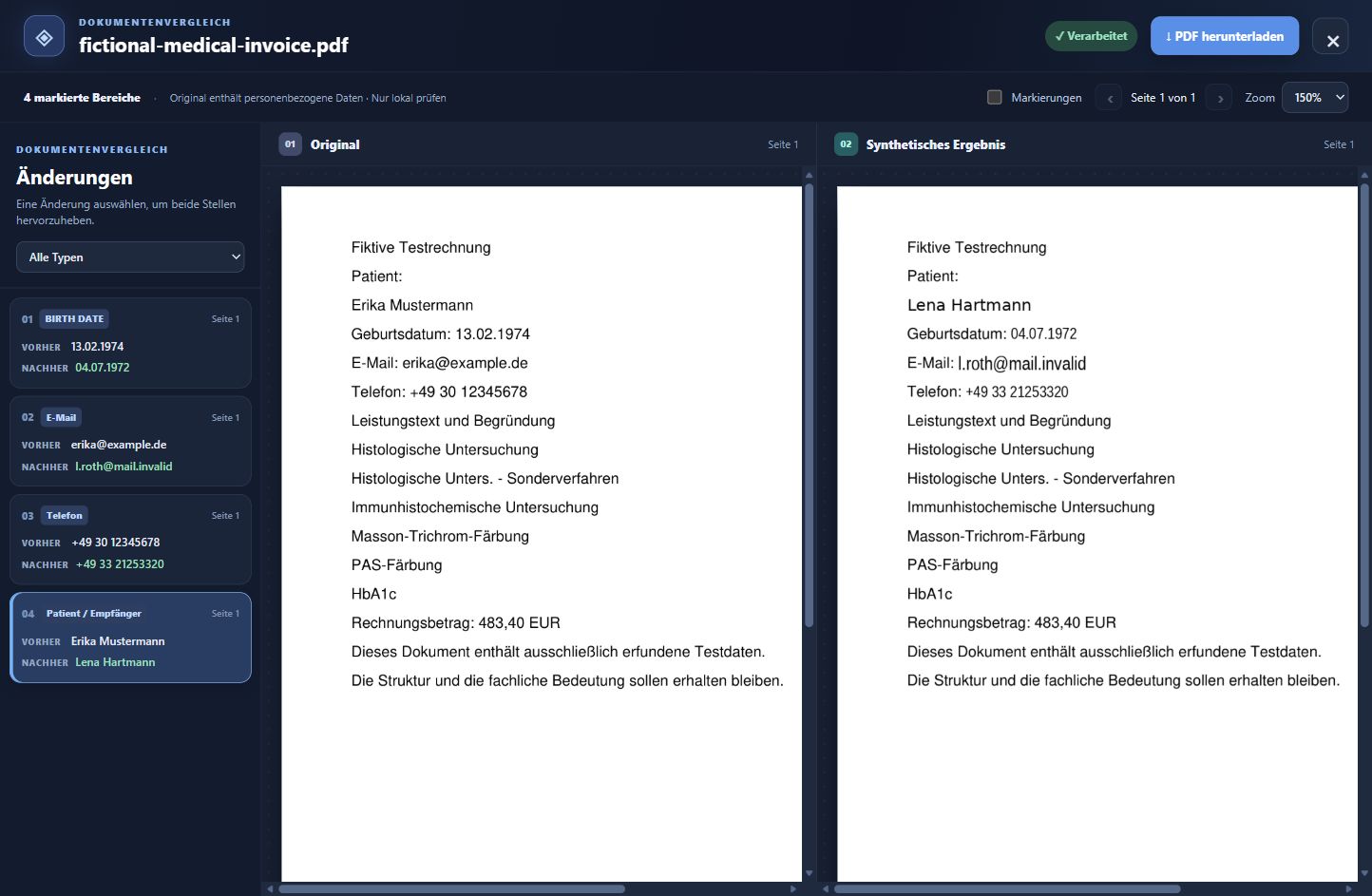
Static comparison of an entirely fictional test document. Personal fields, including telephone, were replaced. The highlighted fields and source/output values can be inspected in the interactive comparison above.
Inspect highlighted fieldsReview newly generated fictional text and labels. The recording shows the development workflow; availability and approval form part of acceptance.
The interface generates new fictional text for PII development. Entity spans and roles are highlighted in the preview. An authorised person reviews the examples and development dataset. No uploaded source documents are used for this dataset. The recording does not establish currently approved source-derived training export.
05 / PROCESS
Associate a PDF, scan, image or text with a job.
Extract text or read it with local OCR.
Recognise personal fields in document context.
Replace recognised identifiers with consistent fictional values.
Read output again and check residual identifiers, readability and domain content.
Release for the intended use only after technical checks pass.
06 / SECURITY
In the on-premises model, intake, processing and output stay inside your infrastructure. Network rules, identity, key management and monitoring are agreed before the pilot.
The documented pilot uses AES-256-GCM for source, output and comparison. Key management and infrastructure encryption require deployment acceptance.
Documented demo state: original preview for 15 minutes, output job for up to one hour. Owners can delete jobs. Customer retention periods are agreed separately.
Jobs are assigned to a user and tenant. Original previews require a reviewer role. Enterprise SSO and the role model are scoped for the target system.
Verification results and acceptance criteria support traceable decisions. Audit integration and immutable archiving are separate integration scope.
Technical verification does not replace a legal anonymity assessment. Context and health information may still be personal data.
07 / DEPLOYMENT
Containers based on Docker Compose in your network. Integration with document storage and test workflows is scoped together.
Customer-managed environment with agreed network and access rules. DMS adapters, SSO and queues form part of the agreed integration scope.
CPU and RAM requirements: on request, based on your document families and pilot measurements. Licensing, integration and support follow the confirmed scope.
08 / PILOT
Two document families and one downstream task provide a focused starting point. Duration and dates by agreement.
Clarify objectives, data ownership and security requirements.
Choose two families and a separately labelled acceptance set.
Measure leakage rate, automation rate, unwanted edits and review effort against agreed thresholds.
Review the findings, integration scope and next steps together.
09 / QUESTIONS
No. Fictional replacement values alone do not establish legal anonymity. Context, rare facts and re-identification risk need assessment for the intended use.
Source-derived training export is currently blocked. It requires separate legal and technical acceptance, a labelling policy and release rules. Newly generated fictional development text is a separate workflow.
Local OCR/NLP processing is CPU-based and uses no LLM or external AI inference API. Capacity is measured with your documents.
Containers and HTTP endpoints provide the foundation. Document vocabulary, DMS integration, SSO, queues and output formats are agreed as a concrete scope.
Request access through the contact section. The separate demo is protected by Cloudflare Access and intended for fictional test data.
10 / PROVIDER
11 / CONTACT
Tell us about your test workflow and document families. We will respond shortly and agree the next step with you.